 TheDubaiVacancy Latest Jobs in Dubai 2026, Apply For Private & Govt Jobs
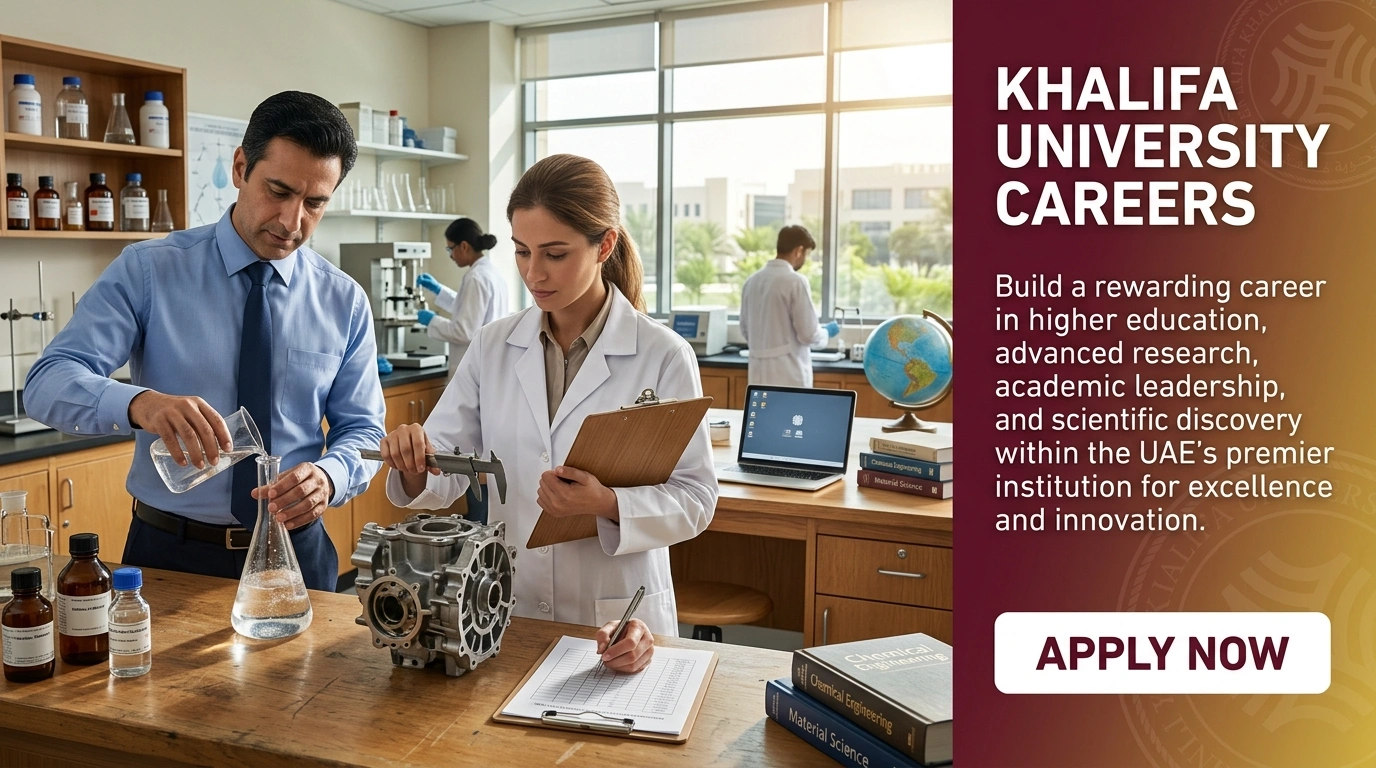
Abu Dhabi’s strategic pivot toward a post-oil knowledge economy relies entirely on localized technological innovation. The recruitment pipeline for Khalifa University Careers feeds directly into the UAE’s most heavily funded research and development engine, completely bypassing the scope of a standard undergraduate teaching college. This state-backed incubator focuses aggressively on aerospace engineering, artificial intelligence, robotics, and clean nuclear energy, operating as a primary intellectual asset for highly sensitive national sectors.
The operational tempo on the academic floors is built entirely around elite research output. Faculty members, principal investigators, and postdoctoral researchers are not brought in merely to deliver textbook seminars. The institutional mandate is brutally clear: aggressively secure specialized research grants, maintain a consistent publication record in tier-one scientific journals, and collaborate directly with massive state-owned entities—like ADNOC, EDGE Group, and the UAE Space Agency—to solve complex industrial engineering bottlenecks.
Sustaining this massive academic infrastructure requires a highly technical administrative and clinical backbone. The university campuses house state-of-the-art medical simulation centers, advanced robotics laboratories, and semiconductor cleanrooms. Consequently, laboratory technicians, IT architects, and academic affairs coordinators must flawlessly manage complex equipment procurement, ensure strict international intellectual property (IP) compliance, and uphold the rigorous accreditation standards demanded by global governing bodies like ABET.
Because the institutional stakes are tied directly to national development, the hiring committee operates with agonizing precision. The Provost and department deans actively headhunt subject-matter experts holding PhDs from globally ranked institutions, prioritizing academics who bring an established portfolio of international research and registered industry patents. Faculty and senior administrators absorbed into this academic ecosystem are compensated under elite Abu Dhabi government salary scales, heavily backed by massive internal research funding and fully paid family education allowances.
Expert Analysis: The Research-First Mindset?
Our View: A common mistake foreign professors make when applying to Khalifa University is focusing too heavily on their teaching philosophy. While pedagogy is important, KU is fundamentally a research institution aiming to boost its global QS rankings. Your application needs to scream “Research Output.” The hiring committee wants to know how many Scopus-indexed papers you publish annually and how much external grant money you can realistically bring into the university.
Critical Tip: “The National Alignment.” Look at the UAE’s ‘Operation 300bn’ industrial strategy. If your academic research directly supports water desalination, renewable energy, AI defense systems, or petroleum engineering, explicitly state how your work aligns with Abu Dhabi’s national interests in your cover letter. This makes your hiring a strategic national asset, not just a departmental hire.
Job Overview: Salary Scales & Benefits (2026 UAE Estimates)
Note: Salaries are tax-free and paid in UAE Dirhams (AED). Academic packages in Abu Dhabi are heavily subsidized. Faculty and senior staff typically receive comprehensive family health insurance, annual flight tickets, generous housing allowances (or provided faculty housing), and tuition fee coverage for dependent children.
| Qualification Level | Est. Monthly Salary (AED) | Position Type |
| PhD / 10+ Yrs Exp. | AED 35,000 – AED 55,000+ | Full Professor / Department Chair |
| PhD / 3+ Yrs Exp. | AED 20,000 – AED 30,000 | Assistant Professor / Postdoc |
| Masters / 5+ Yrs Exp. | AED 15,000 – AED 22,000 | Senior Lab Technician / Registrar |
| Bachelors / 2+ Yrs | AED 8,000 – AED 14,000 | Academic Advisor / IT Support |
Key Departments Hiring at Khalifa University
An elite research university is divided into highly specialized colleges and operational divisions. You must align your academic focus or technical background perfectly with the correct silo:
1. College of Engineering & IT
- Target Roles: Faculty (Aerospace, Biomedical, Nuclear), Postdoctoral Fellows, and AI Researchers.
- The Daily Grind: The technological spearhead. This college houses the most aggressively funded projects on campus. Faculty spend their days managing graduate students, running complex simulations on university supercomputers, and physically testing materials in the advanced composites labs. You are expected to continuously generate patentable technology.
2. College of Medicine & Health Sciences
- Target Roles: Clinical Professors, Anatomy Lab Managers, and Medical Researchers.
- The Daily Grind: The clinical frontier. Modeled on top North American medical schools, this division blends intense student instruction with cutting-edge public health research. Clinical faculty divide their time between teaching complex anatomy, running the high-fidelity medical simulation wards, and conducting localized genetic research on regional GCC health trends.
3. Academic Support & Student Success
- Target Roles: Registrars, Admissions Officers, and Student Life Counselors.
- The Daily Grind: The operational backbone. You are managing the daily lives of highly ambitious Emirati and international students. This involves executing flawless enrollment logistics, maintaining strict academic records, organizing massive university career fairs with local government employers, and ensuring students meet strict graduation requirements.
The Reality of Academic Careers: Publications & Procurement
Transitioning into the Gulf’s premier R&D sector immediately shatters the typical pacing of western tenure-track systems. Although heavily subsidized academic jobs in UAE attract thousands of global applicants annually, surviving inside Abu Dhabi’s state-backed research hub requires massive operational resilience. The reality of working on the Khalifa University campus forces foreign faculty to abandon slow academic timelines and adapt instantly to ruthless publication quotas, heavily scrutinized state procurement bottlenecks, and deeply nuanced classroom dynamics:
- The Q1 Publication Mandate
The university’s global QS ranking is directly tied to faculty citation volume, meaning there is zero room to rest on past achievements. You are aggressively mandated to publish consistently in Q1 (first quartile) international journals. If your laboratory fails to produce high-impact, Scopus-indexed papers or secure external corporate partnerships, your contract renewal will be immediately blocked by the Provost.
- State-Level Procurement Gridlock
Equipping a high-level aerospace or chemical engineering lab involves navigating dense government bureaucracy. Because KU is a state-affiliated entity, importing restricted chemical compounds or purchasing a two-million-dirham electron microscope triggers massive internal finance and compliance audits. Principal Investigators (PIs) must execute flawless supply chain forecasting, as simple hardware purchase orders can easily be delayed by months of regulatory red tape.
- Classroom Demographics and Nuance
The student body features the highest-performing Emirati youth in the country. However, lecturing here requires a razor-sharp balance between enforcing strict academic rigor and demonstrating deep cultural intelligence. Professors must uphold absolute academic integrity and attendance mandates without alienating the local demographic. Navigating local communication nuances and demonstrating absolute respect for UAE leadership and Islamic traditions is a non-negotiable survival trait on campus.
Featured “Hot” Vacancy: Postdoctoral Researcher – Artificial Intelligence & Robotics
The Center for Autonomous Robotic Systems is actively seeking a highly published Postdoctoral Researcher to lead development on computer vision algorithms for unmanned aerial vehicles (UAVs).
- Estimated Salary: AED 22,000 – AED 26,000 per month (plus housing).
- Location: Khalifa University Main Campus, Abu Dhabi.
Requirements:
- PhD in Computer Science, Robotics, or Electrical Engineering from a top 100 globally ranked university.
- Proven track record of first-author publications in tier-one conferences (e.g., CVPR, ICRA, NeurIPS).
- Deep, hands-on programming expertise in Python, C++, ROS (Robot Operating System), and PyTorch.
- Previous experience securing government or defense-related research grants is highly advantageous.
How to Apply for Khalifa University Jobs (The Real Way)
Academic talent acquisition runs on rigid semester cycles and global grant periods, completely detaching it from standard corporate hiring speeds. Gaining a seat on the faculty or in an advanced R&D lab requires proving your direct scientific value to Abu Dhabi’s industrial goals. Here is the exact submission protocol:
Step 1: The Academic Gateway
Sourcing begins exclusively at the Khalifa University Careers Portal. Discard the standard corporate resume format. University search committees demand a hyper-detailed Curriculum Vitae (CV). Your uploaded profile must immediately highlight your current H-index, total lifetime citations, exact monetary values of previously secured research grants, and a specialized “Statement of Teaching and Research Interests” tailored explicitly to UAE national security or sustainability objectives.
Step 2: Global Symposium Interception
High-level professorships are rarely awarded to cold digital applicants. KU department chairs and college deans actively deploy to major global symposiums (such as international IEEE conferences or the World Future Energy Summit) specifically to scout elite talent. Delivering a keynote or presenting peer-reviewed data at these exact summits puts you physically in front of the hiring panel, allowing you to sidestep the digital HR screening entirely through peer-to-peer scientific networking.
Step 3: Pitching the Principal Investigator (PI)
For Postdocs, lab technicians, and specialized research engineers, relying solely on job boards is a mistake. Find the active “Principal Investigator (PI)” running the specific KU research center that matches your exact niche. Transmit a dense, data-heavy research proposal detailing how your expertise can solve a current engineering bottleneck in their active grant. PIs possess massive internal leverage; if you bring immedsiate value to their laboratory, they can petition the Provost to generate a custom hiring allocation just for you.
Advertisements
